This page will change as more state guidance is provided.
What is a homestead vendor?
Actually, two new vendor types were created in 2026, homestead vendors and small farm operators (HEA 1424, 2026). The statutes for home-based vendors still remain enforced (IC 16-42-5.3). However, the new statute under IC 16-42-5.4 expands what foods can be sold by homestead and small farm vendors.
A homestead vendor means a person that prepares and sells food products or meat products from:
- Property or at a farmers market; and
- Which the person does not receive more than $1.5 million in gross sales from food products or meat products in a single year.
What is a small farm?
Small farm means land:
- That is used primarily for growing crops or raising livestock;
- From which a person prepares and sells food products and
- From which not more than one million five hundred thousand dollars ($1,500,000) in
- gross sales is received from:
- a) Meat products;
- b) Cultivated or harvested crops; or
- c) The sale of food products; in a single year.
What food can a homestead vendor sell?
This document will change frequently as further guidance is provided by the state.
The new statute does not supersede federal law. This document tries to make note of when that might leave a question.
Jasper Farmers’ Market is a producer market. As such, homestead vendors may only sell produce they have grown or have received by an immediate family member or close friend.
Where homestead vendors are selling prepared foods (TCS or non-TCS), the produce requirement still exists with the exception of produce not able to be grown locally and pantry stock items (e.g. olives, avocados, red pepper flakes, etc). This means homestead vendors selling products like salsa, relish, jelly, pickles, casseroles, and deli sandwiches must grow all produce in those items where applicable.
Furthermore, at least 50% of the produce in prepared foods must also be sold by the vendor in their booth. This informs the customers that homestead vendors are the source of their produce. Any non-produce ingredient included and not grown or made by the vendors must be clearly labeled such for the customer (e.g. meat, bread, cheese).
Where homestead vendors are selling foods like cookies, breads, and brownies or drinks like lemonade where the finished item contains no produce that can be grown locally then there is no requirement to sell produce or fruits used in production (because there isn’t any).
If a homestead vendor has a food handler permit they may operate as both a home-based vendor where they have advantage and as a homestead vendor where there have advantage. It is my recommendation that homestead vendors have a food handler permit.
As a producer market, our customers trust us to ensure vendors have grown the produce and have made any food being sold. These rules are our attempt to keep that trust.
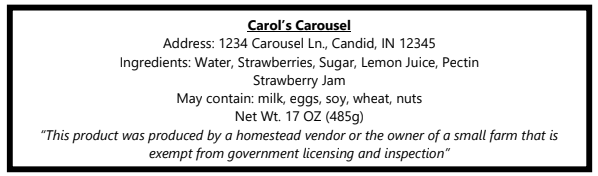
Examples of homestead vendor food
Anything that can be sold by home-based vendors can be sold by homestead vendors. The examples listed below will focus on the differences not found on the home-base vendor page. I recommend you check there if you do not find what you are looking for here.
This page will change as more state guidance is provided.
We are a producer market. This means there is a requirement that all produce must be grown by a vendor with the exception of produce not able to be grown locally and pantry stock items.
This list is not all inclusive.
| Food Type | Examples Allowed | Examples Prohibited |
| Baked Goods | Items containing less than 2% cooked meat. Items containing dairy or egg Casseroles, quiche, and other items requiring refrigeration | Items containing more than 2% cooked meat1 |
| Candies and Confections | Anything freeze dried | Yogurt |
| Fruit and Vegetables | Produce4 Prepared salads Non-fruit based jams and jellies made from jalapenos, daisies, tomatoes, etc. Low-sugar jelly and jams Fruit butters Pickles, relishes, salsa, chutney, and other acidified food Raw seed sprouts Garlic in oil mixtures, herbs and oil mixtures Canned vegetables Anything freeze-dried or dehydrated excluding meats. | Items containing more than 2% cooked meat1 |
| Meat, Poultry, Eggs, and Seafood | Meat vendors are required to meet all federal regulations. Fresh chicken eggs still require an ISEB. Frozen poultry1 & rabbits Pickled eggs Cooked or cured deli meats (sandwiched) | Items containing more than 2% cooked meat1 Canned meats and seafood Cooked non-deli meats (burgers, meat loaf) Tallow1 |
| Tree nuts and legumes | Nut butters (also allowed for HBV now) | |
| Beverages | Coffee and cold brew coffee | Kombucha1 Raw milk3 |
| Syrups, Dressings, Vinaigrettes | Acidified vinaigrettes or dressings | Items containing more than 2% cooked meat1 |
| Prepared Foods | Pre-packaged meals (meals prepared and sealed for later consumption) Deli Sandwiches5 Soups and salads Ready-to-eat snacks (snack cups, packaged cheese and crackers, etc.) Meal kits6 | Items containing more than 2% cooked meat1 Items containing more than 3% raw meat without federal inspected package and label1 |
- Requires federal inspections or is federally regulated.
- Less than 1,000/year
- HEA 1424 only encompasses exemptions for food products intended to be consumed by humans. Pet food (including raw animal milk) regulations have not changed, and inquiries should be directed to the Office of Indiana State Chemist.
- A homestead vendor or small farm must only sell produce with an annual gross income of less than $25,000 to be exempt from the federal produce safety rule for produce intended to be consumed raw. Annual sales in an amount above $25,000 are subject to inspection.
- A deli sandwich is deli meats between two slices of bread or in a wrap with toppings. Deli sandwiches are exempt from federal inspection. Deli meats are pre-cooked or cured and sliced for use with a deli item (e.g. ham, salami, pastrami).
- Meal kits can exceed meat inspection limits as long as the included meat remains in federal inspected packaging.
Can you summarize HSV for me?
Essentially, anyone with a garden or raising cattle can be a homestead vendor. If this is you, then this is a summary of what you can do. (This will change as guidance is provided.)
You can sell deli sandwiches. A deli sandwich is deli meats between two slices of bread or in a wrap with toppings. Deli meats are pre-cooked or cured meats (e.g. ham, salami, pastrami) sliced for use with a deli item. Deli sandwiches are exempt from federal inspection.
You can sell vegetarian casseroles or vegetarian pizzas. Maybe even casseroles or pizzas with meat provided the amount of the meat does not exceed 2% cooked or 3% raw (including broths or any other meat based ingredient). An amount in excess of those percentages requires federal inspection.
You can sell meal kits. This means you can package together all the ingredients for a meal and sell it as a kit. This includes meats, regardless of limits, as long as it retains its FDA inspected label and package. If you are selling at the market then obvious ingredients must be frozen. If you are selling from home then they can be thawed.
You can sell canned salsas, pickles, relishes and other acidified foods; however, all federal regulations and labeling must be followed. Cheese and other dairy items are still prohibited until further guidance can be provided.
At the Jasper Farmers’ Market, you may only sell produce you have grown or have received by an immediate family member or close friend. Furthermore, you must also be selling at least half of the produce in your booth so customer can be assured you are growing it.
In short, an HSV can sell everything an HBV can and then some…and without a food handler’s certificate. However, they cannot sell everywhere an HBV can. Should an HSV have a food handler’s certificate they can operate as an HBV selling non-TCS (Time/Temperature Control for Safety) foods in those places.